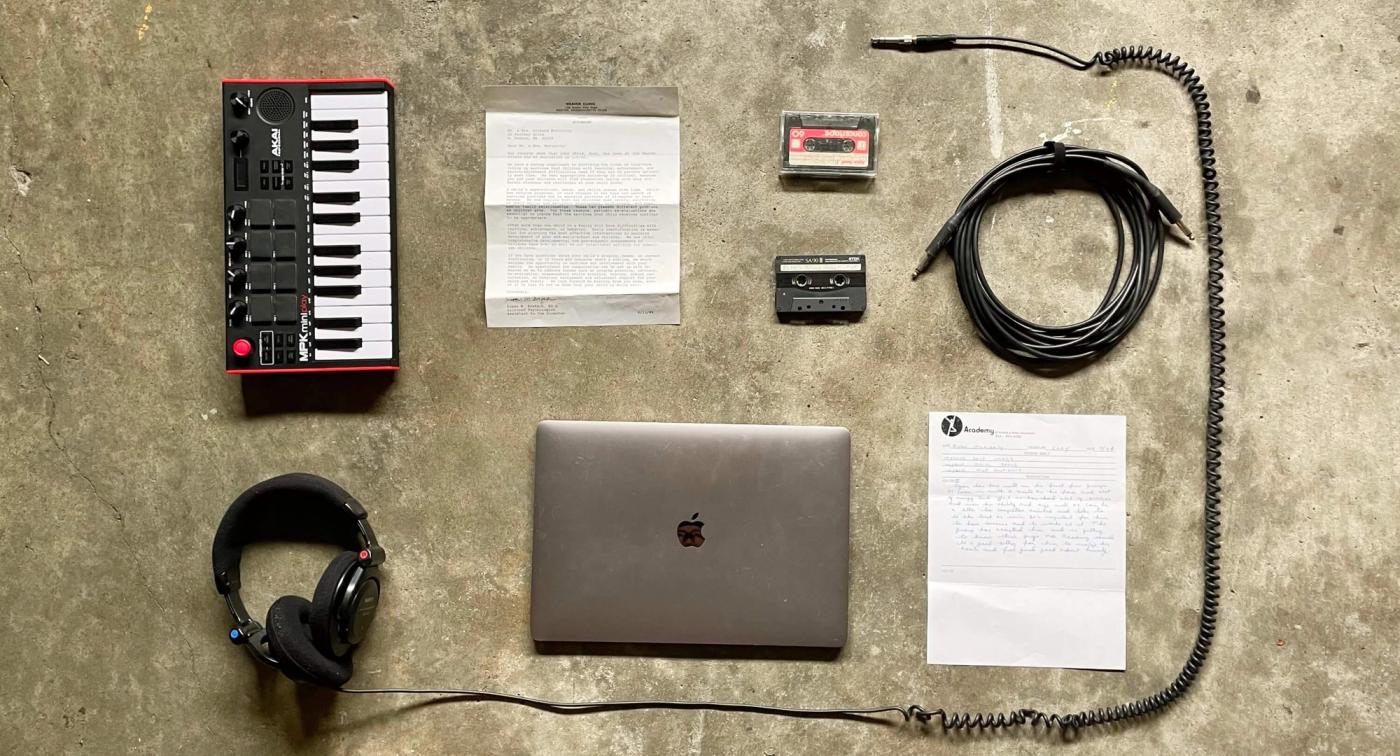
I was seven years old the first time someone put a name to how my brain worked. Not that I fully understood what that meant at the time. I just knew school required something from me that it didn't seem to require from everyone else. Something about the way I moved through the world, socially, academically, internally, was operating on a different frequency.
I remember a phonics program my school used. Color coded letters. Light blue for lowercase e. Green for this one. Yellow for that one. The teacher moving through the lesson with confidence while I sat there not yet understanding what a letter was, let alone what the colors were supposed to mean. The program assumed a foundation I hadn't built yet.
I wasn't slow. I was just somewhere else entirely.
The math flashcard competitions were worse. Two lines of kids facing each other. Your turn comes, a card goes up, first one to answer wins and stays in. The losers sit down. I was always out in the first round. Not because I couldn't do the math eventually. Because by the time I'd finished reading the question the other kid had already answered it. I watched certain kids get celebrated by the teacher, applauded by the room, over and over. I watched from the sidelines every time. And man, that felt really crappy.
My parents saw it before I had language for it. Both of them, equally. My mom went to my school's principal and demanded testing when the answer was no. She sat across from him and didn't leave without a path forward. My dad brought the same energy from a different angle. They both grew up in the 50s and 60s, a time when you fell in line or got labeled. No support, no framework, no language for what a brain like mine was actually doing. I have my suspicions they both knew something about that from the inside. They never said so. But the conviction behind that meeting, we will have him tested, this is not optional, didn't come from nowhere. It came from two people who weren't going to let the system decide what their kid was capable of.
They paid for a private evaluation. That led them to the Weaver Center, where the real work began. Specialists who helped me relearn how my brain processed things. I didn't fully understand what was happening at the time. To me it felt like going somewhere cool to do interesting tests and have good conversations. That was by design. The work was serious. The experience never felt like it.
Shortly after, they found the Academy. From early elementary I went there regularly, a program built around developing social skills and confidence through play, creative games, physical challenges, inventive activities with real objectives underneath the fun. I didn't experience it as an intervention. I experienced it as one of the best places I got to go. I had my birthday parties there. I loved it. That's how well my parents threaded the needle. I never felt like a problem to be solved. I felt like a kid who got to do cool things.
The Weaver Center stayed in the picture through grade school. A friendly home base. I'd go in, do some cool tests, talk through things, never quite registering that what was actually happening was specialists continuing to help me understand and work with my own brain.
The resource room at school ran alongside all of it. Leaving class daily to work with other kids who had learning differences. The other kids saw that room a certain way. I knew what the looks meant. What kept me connected, honestly, was size and athleticism. Sports kept me in the community, kept me visible enough that the daily exit didn't define me socially. But I knew. You always know what the looks mean even when nobody says anything out loud.
Then fourth grade. We moved to Cape Cod. The support infrastructure stayed in Newton. The Academy, the community, the friends who knew me, all of it. What arrived instead was a physically isolated place. A man made island, separated by a channel and a bridge, with a particular insularity to match. And socially it felt like everyone had aged five years overnight. Status, clothes, whether girls liked you. I just wanted to run around and do imaginary play for a few more years. I wasn't ready for what Cape Cod was asking of me socially and Cape Cod wasn't interested in waiting.
I had people around. Sports kept me in the mix. But they weren't my people yet. Or more accurately, I didn't know how to be comfortable enough in myself to let them in. That takes time for some people. It took me until middle school to start finding footing. Until music to find myself fully.
Junior year of high school I took a creative writing class. The teacher was exceptional. Not because she was technically rigorous but because she wasn't. She created space to just let it flow. Grammar and structure took a back seat. What mattered was the idea, the voice, the thing you were actually trying to say.
I wrote a lot. Song lyrics, short stories, thoughts, feelings, strange ideas that didn't fit anywhere else. It felt good in a way that most school didn't. She told me I should submit work to the school's literary publication. I never did. I was writing for myself. The output wasn't the point. The process was. And that distinction, which I couldn't have articulated then, turns out to be one of the most important things I know about how I work.
I never learned another artist's song all the way through. Not once. It never interested me. Too rigid. Someone else's pattern, someone else's decisions, someone else's flow. What I wanted was to make something. The joy was in the formulation. Solo or with bandmates, starting from nothing and seeing where it went.
The things we created brought in people from everywhere. Friends who didn't even like heavy music. They came anyway and they stayed. Especially during the free form jams between songs at parties, extended, unplanned, just the room and whatever was happening in it. A singer's girlfriend pulled me aside once and tried to explain what she was hearing. The patterns. The way ideas connected and built. The way it all tied together into something that felt like its own thing.
Receiving that kind of recognition was uncomfortable at first. I didn't feel like I was doing anything groundbreaking. It was just how I heard things, how I made things. But something about being seen that clearly, by people who had no reason to flatter me, started to shift something.
The last two years of high school and into college I found the right people. A friend group that reflected something back. You're worth it. Bring your whole self. Stop trying to fit a shape that was never yours. That pivot changed everything. The world got bigger almost immediately. New experiences, new people, new territories I hadn't known were available to me. A sense of how expansive life could actually be.
I've held onto that lens my entire life. No matter what has been thrown at it.
By the time I got into the professional world I was done thinking about any of it. The intervention had worked. The support had worked. The music and the friendships and the expanding world had worked. I walked in confident, genuinely so, and I delivered. Time and again. The big picture view, the speed, the connections nobody else was making. I was good and I knew it and I got on with it.
What I didn't account for was the tax.
Not struggle. Not failure. Just the steady cost of operating at full output while quietly translating everything, my non-linear thinking into frameworks others expected, my instincts into language others requested, my way of seeing into a format the room could follow. The neurodivergent mind makes most of the concessions. The translation runs one direction more than the other. And I was doing it all day every day while projecting that none of it cost anything.
At the end of most days there was a tiredness that had nothing to do with the hours worked. Not burnout. Just steady abrasion. Twenty four grit sandpaper, extra coarse, slowly cheesegrating through. I'd get home and need to decompress in ways I couldn't fully explain. I chalked it up to grit. To drive. To being the kind of person who gives everything.
It took years to be honest about what was actually happening. That maybe I hadn't kicked the neurodivergent thing to the curb as cleanly as I thought. That pretending otherwise wasn't strength. It was just expensive. A crutch I refused because I thought refusing it made me tougher. What it actually did was make the work harder than it needed to be for longer than it needed to be.
But I learned something from every concession. I became fluent in both languages. And that fluency, knowing how to move between my own wiring and the world's expectations, turns out to be a skill most people don't have. I know exactly where my edges are.
The same wiring that made me useful existed inside structures that didn't always know what to do with it. The creative path I might have followed didn't happen. Not from lack of ability. The translation burden was too high and it cost too much of what I loved about making things. High school I was putting in grueling hours every night just to keep up. That kind of effort, sustained over years, takes something out of you. And somewhere in the professional years the cost of translating constantly started to outweigh the return.
So I found ways to weave creativity into the work that was available, operations, brand, creative leadership. It wasn't the retreat it could have been. The creative instinct didn't disappear. It just learned new terrain.
The creative instinct didn't disappear. It just learned new terrain.
The creative instinct didn't disappear. It just learned new terrain.
Something got set down along the way. I knew it. You always know. But what I carried forward was real and it compounded. And I'm still here, still making things, still finding new territory.
I didn't have anything like this when I was seventeen, writing in that class. No tool that could hold the structure while the ideas moved. On the writing side AI has changed that. Not by giving me anything to say. Just by holding the architecture so the thinking stays mine and the flow stays intact. The translation burden lifts enough that the real work can move.
Brain to instrument. Mind to the arrangement, the production, the sound. That process is mine alone and I have no interest in changing it. I'm precious about it. And I'm fine with that. Because I'm strong there. The flow exists without any help. Knowing the difference, where a tool serves you and where it doesn't, that's the whole game.
Business is business. Creativity as a service has always been a commodity and AI accelerates that. If the goal is speed and cost efficiency the tools exist and they will only get better. That's not going away.
The creators will always matter. Because there will always be people who can feel the difference between something made with genuine passion and something produced for output. That audience exists. It's probably you. It's definitely me.
This essay exists partly because writing found new energy in me recently. The momentum is real. The flow is back in a way it hasn't been for a while and I'm not taking that lightly.
Writing is just the start. Code and other experiments are already underway.
The music though. That's still just mine. Always will be.
I voyage out into the dark unknown. Hopeful. Still making things. Still in it.